I've been living in Maine a long time now and know well the annual return of the tourists flocking in like locust to feast on our lobster, rage on our roads, and tear up our lakes. I used to be one of the locust. I know the routine -- here they come, here they spend their money, there they go. I get it.
It typically doesn't bother me. I can move patiently and peacefully through the traffic with all the lane-changing shenanigans, beeping, and gesturing of the out-of-staters because it is not unlike navigating a middle school hallway. And the crowds in town do not usually bother me either because I spend the school year going around in the classroom between bodies that don't move when they see you struggling to get past them with a stack of a dozen textbooks that weight 15-pounds each.
But what on earth is going on this summer? It seems that there are just so many of them! And they are either zipping past you angrily or standing there dumbfounded. Maybe it's the lower gas prices. Or maybe nobody knows what's going to happen after the election in November, given the candidates, so it's all a last-ditch attempt to experience the way life should be. If you can't find it in Maine, what hope is left?
The cause of my rant was what should have been a simple trip to
Hannaford Supermarket in Windham this morning. The two mile drive from my house took a little longer as we all had to slog along behind a camper pulling a sedan, pulling a boat, pulling a trailer with five bicycles and a grandmother in a rocking chair. O.K. That is all to be expected. Family vacations require a lot of stuff.
When I finally did arrived, it was a slower crawl to even get into the parking lot. This was due to a funeral procession that was swinging past the front of the supermarket.
Or, so I thought. On second glance, it was a line of SUV's, all of them black, all of them with out-of-state license plates, running their AC with the passengers inside. They were lining up for their curbside pickup of groceries.
Well, this I understand too. If I had just driven hours through traffic with kids, dogs, and grandmother, I too would pull up and have someone fill my cars with groceries before I headed to the cabin on the lake. One less thing to worry about during a well-deserved vacation.
What I didn't expect was the mayhem inside the store. People, so many people! There was a swarm at the deli counter, waving their numbers like they were on the floor of the New York Stock Exchange, babies crying, peaches rolling on the floor through the produce area. Peaches!
Carriage traffic was jammed up behind what looked like little Zamboni machines everywhere blocking aisles. But this was not an ice arena and the Zamboni's were actually large silver carts filled with grocery bags, driven very, very, VERY slowly by very stressed employees trying to fill the orders for the vacationing people lined up outside in their SUV's. It takes a long time because they are following a precise list sent through earlier online by the precise shoppers.
You know it's bad when the disabled people in the electric shopping carts start ramming their way through. After getting pegged in the back of the knees and my toes nearly run over by one eldery man making a run on sweet potatoes, I learned to listen for the ssszzzttt sound of the electric motor winding up prior to the bursts forward.
I don't know if there were more people using electric carts today or it seemed like there were more of them because I was on high alert for another affront to the back of my knees, but the electric carts seemed to be everywhere.
I have to give Hannaford credit. There were employees in all the right places helping people, all hands on deck, every register open. One voice called out to me, a bright-eyed young man stacking jars of pickles as fast as people were snatching them off the shelf. (I must have had a look of anguish on my face.)
"How are you today, ma'am? May I help you find something?"
And I found myself thinking a thought no teacher in her right mind, on summer break ever should: September. Just September.
 My time has come. It was a very long ride of not ever thinking about my weight and there was even a spell of having to eat to keep my weight up. Then came "Oh, look! I have curves!" when I looked in the mirror, which was amusing at first. Now, not so much. My time has come to lose weight.
I tried to act surprised when I stepped on the scale at my recent medical appointment. "Well, what do you know! Look at that, will you!" But I knew it was coming. My doctor recommended the Whole30 plan with tremendous enthusiasm and first-hand experience, as she has been on it several years. (She looks fabulous, by the way.)
The Whole30: The 30-Day Guide to Total Health and Food Freedom by Melissa and Dallas Hartwig is a heavy book that Amazon Prime got here lickety split. With the exception of the many recipes that make up the later half of the book, I have read all the rules, regulations, advice, guidelines, explanations and plans and am ready to begin on Monday.
In a nut shell -- which is important, because you do keep it very simple and you do eat a lot of nuts -- you follow a very strict diet for 30 days and then reintroduce foods after that and see how they affect your body and your weight. The basics: no sugar, no alcohol, no dairy, no grain, no legumes, no exceptions. Losing excess weight is a side benefit, as the diet is really intended to target your gut bacteria and the inflammatory response, which my developing osteoarthritis and my skin issues will hopefully thank.
I have heard that with any good diet should come advice on lifestyle changes and rethinking relationships with food consumption. The Whole30 book devotes a great deal to this and as I read, I came across something that made me think about my students and my growing aversion to snacking in the middle school classroom and had to write about it here
I have kept my classroom snacking disdain under wraps for a while now because I do not want to ever become that old persnickety teacher with the perpetual scowl. (If I do, put me out to pasture). But I have found allies in Melissa and Dallas Hartwig on the issue, so let's talk about it.
The current rational for having students snack sometime between when they arrive (at our school it is 7:30 am) and when they get to lunch (11:20 am for our 7th graders) is two-fold. First, many 13-year-olds say they don't eat breakfast. And second, even if they did eat breakfast, they need to eat again before lunch because their metabolisms are high, their blood sugar drops, or they are simply growing so fast that the food needs to keep going in.
All of these are true. Most of my students say they are STARVING all the time and so the crumply-bagged snacks and small plastic ware containers from home enter into the classroom. Kids eat and we go on learning without much incident most of the time.
If you walked into our classroom during the middle of the school year, you wouldn't really notice the issue. That's because it takes a lot of management from my end to get there.
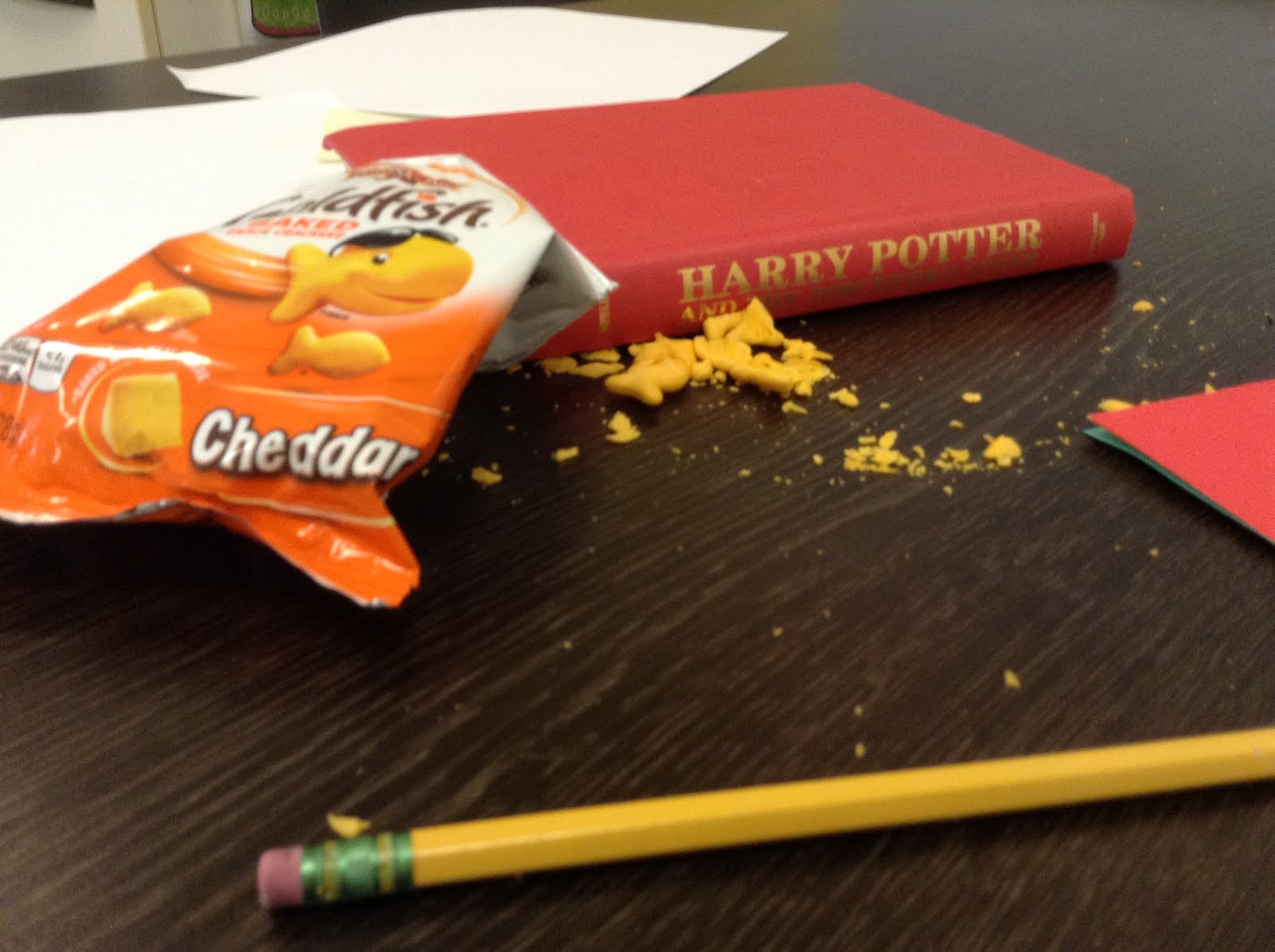
There is the snack-begging to control. At some point, a student will stroll in with a Family-Sized box of Cheez-It crackers tucked under his arm or a Picnic Day Extravaganza-Sized bag of SmartFood balanced on top of her books, and it turns into a feeding frenzy.
"Can I have some?" The cries erupt. Hands are outstretched. Chairs go flying. And there's me in the center saying, as I so often do, "What's happening?"
It's all fun and games until someone calls out, "Where's the broom?"
So management has to step in. That's me. "Here. Napkins. Pour out what you will eat and what you want to share at your table, then put the rest in your locker." Sometimes that directive in itself turns into a tussle.
The detritus of snacking is a problem too. I have to remind students often to take care of their trash because once the snack has been eaten, the wrappers and the small plastic ware that once contained them, are no longer within the vision of the student. It's as if it no longer exists in their physical realm. Many simply don't see their own wrapper.
My time has come. It was a very long ride of not ever thinking about my weight and there was even a spell of having to eat to keep my weight up. Then came "Oh, look! I have curves!" when I looked in the mirror, which was amusing at first. Now, not so much. My time has come to lose weight.
I tried to act surprised when I stepped on the scale at my recent medical appointment. "Well, what do you know! Look at that, will you!" But I knew it was coming. My doctor recommended the Whole30 plan with tremendous enthusiasm and first-hand experience, as she has been on it several years. (She looks fabulous, by the way.)
The Whole30: The 30-Day Guide to Total Health and Food Freedom by Melissa and Dallas Hartwig is a heavy book that Amazon Prime got here lickety split. With the exception of the many recipes that make up the later half of the book, I have read all the rules, regulations, advice, guidelines, explanations and plans and am ready to begin on Monday.
In a nut shell -- which is important, because you do keep it very simple and you do eat a lot of nuts -- you follow a very strict diet for 30 days and then reintroduce foods after that and see how they affect your body and your weight. The basics: no sugar, no alcohol, no dairy, no grain, no legumes, no exceptions. Losing excess weight is a side benefit, as the diet is really intended to target your gut bacteria and the inflammatory response, which my developing osteoarthritis and my skin issues will hopefully thank.
I have heard that with any good diet should come advice on lifestyle changes and rethinking relationships with food consumption. The Whole30 book devotes a great deal to this and as I read, I came across something that made me think about my students and my growing aversion to snacking in the middle school classroom and had to write about it here
I have kept my classroom snacking disdain under wraps for a while now because I do not want to ever become that old persnickety teacher with the perpetual scowl. (If I do, put me out to pasture). But I have found allies in Melissa and Dallas Hartwig on the issue, so let's talk about it.
The current rational for having students snack sometime between when they arrive (at our school it is 7:30 am) and when they get to lunch (11:20 am for our 7th graders) is two-fold. First, many 13-year-olds say they don't eat breakfast. And second, even if they did eat breakfast, they need to eat again before lunch because their metabolisms are high, their blood sugar drops, or they are simply growing so fast that the food needs to keep going in.
All of these are true. Most of my students say they are STARVING all the time and so the crumply-bagged snacks and small plastic ware containers from home enter into the classroom. Kids eat and we go on learning without much incident most of the time.
If you walked into our classroom during the middle of the school year, you wouldn't really notice the issue. That's because it takes a lot of management from my end to get there.
There is the snack-begging to control. At some point, a student will stroll in with a Family-Sized box of Cheez-It crackers tucked under his arm or a Picnic Day Extravaganza-Sized bag of SmartFood balanced on top of her books, and it turns into a feeding frenzy.
"Can I have some?" The cries erupt. Hands are outstretched. Chairs go flying. And there's me in the center saying, as I so often do, "What's happening?"
It's all fun and games until someone calls out, "Where's the broom?"
So management has to step in. That's me. "Here. Napkins. Pour out what you will eat and what you want to share at your table, then put the rest in your locker." Sometimes that directive in itself turns into a tussle.
The detritus of snacking is a problem too. I have to remind students often to take care of their trash because once the snack has been eaten, the wrappers and the small plastic ware that once contained them, are no longer within the vision of the student. It's as if it no longer exists in their physical realm. Many simply don't see their own wrapper.
Others do see it but are sneaky. Rather than walk to the bin to dispose of the trash, they invent some impressive ways of hiding it. There's always origami. I've found cranes made out of Cool Ranch Dorito bags and endless other shapes and bags folded and jammed into unusual places around the room. One that gets me every year is the small, strategically-placed plastic container aligned on a book shelf in front of a book spine of the same color as the lid. It usually hides for quite a while until the residue on the inside of the translucent part begins to decompose and change color and then the gig is up.
Aside from the management part, I am more concerned about why kids are so hungry and the choices of food that are available to them for snacking and for meals. Most of the snack choices I see on a daily basis are not healthy and lunch portions and the quality of the food not so good. So are kids really STARVING all the time? Well, technically not starving but they certainly are hungry and in need of nutrition.
The authors of Whole30 are not fans of snacking and here's why. They believe snacking between meals can disrupt the normal hormonal functions which then increase the feeling of being hungry more often which forces you to eat more snacks and not enough at meal times. They advocate eating three or four full meals and increasing the quality and quantity of each meal, rather than snacking if you feel hungry. They emphasize eating in each meal more protein and more fats (yes, fats -- good fats) to help the hunger.
With all the growing and hormones flying around in middle school, and the obvious fact that a classroom should be a place of learning, shouldn't we be focusing more on the quality and quantity of meals and not encouraging snacking during class? Can we ever imagine a school where meals of high-quality protein and a fabulous variety of organic vegetables and grain dishes are served in a way that truly nourishes students so they do not feel so hungry?
I don't know what the solution is within the reality of what I see right now. I do know that students are rushed in the morning. I do know that young adolescents would mostly prefer to start school later (which would give them more time perhaps to eat a larger breakfast). I do know that some students do not have food in their homes or a parent who is watching over their nutrition. And I do know that time for lunch, as well as the school lunch program, are limited.
So they will continue to snack in the classroom for now; I won't. And when it comes to the larger issue of student nutrition, I'll follow Ghandi's advice: "Be the change you wish to see in the world." Over the summer I'll learn some more about this Whole30 idea and come back in September, ready to manage the student snacking in my classroom, a little more slim and a little less persnickety.
 The day after the 4th of July, I am still seeing a lot of flag action as I scroll through my Facebook feed. I like the one of the red and white stripes superimposed over amber waves of grain, and also the historical painting of the founding fathers standing next to the flag, looking dapper in their tights and tri-corn hats as they sign their lives away on the Declaration of Independence.
A day after and flags still keep coming -- draped behind a bald eagle, swaddled around a newborn baby, flapping out of a rear window of a pickup truck. The quotes "Freedom Isn't Free!" and "Home of the Free, Because of the Brave!" are often paired with the pictures.
Some people get a little over excited about it all and that's when the fun begins with the comments. There's one picture of a guy lighting the tip of a flag on fire that elicited cries of desecration: "Burn the guy!" and "He should be shot!"
While I like a good parade and feel deep gratitude for being born a U.S. Citizen, I do not get too worked up over the flag itself and all the rigmarole that goes along with it. The flag, after all, is a piece of cloth on a stick -- often made in China -- that symbolizes, for many people, the power, freedom, and unity of our country.
One of the posts featured what looked like a child of the 1950's standing in a classroom with his hand on his heart, his eyes earnestly looking up at Old Glory. There were words that suggested that all of what's wrong with America today will be solved if those darn schoolteachers would just go back to making children say the Pledge of Allegiance every morning. I've seen this one before and this one always gets me. Where are the classrooms that are not saying the Pledge? I have taught in four school districts in Maine and in each of them, we have always started the day with the whole school saying the Pledge of Allegiance. Over the years, I have had three students who did not say the Pledge due to religious reasons and a couple more who chose not to say it just because they felt like being rebels. The rebels never really did find their cause and eventually went back to reciting it along with their classmates. In either case, I did not make a big deal out of. My only rule is to be respectful of those who do choose to stand and say it.
This idea that the younger generation is somehow deficient in patriotism and slacking off on being good citizens seems to have taken hold among the older generation. A couple years ago, Newsweek Magazine did a survey that turned into a mockery of young Americans. The survey had two questions: 1. Who lives at 1600 Pennsylvania Avenue? and 2. Who lives in a pineapple under the sea? I don't remember the specifics of how the survey was conducted, but apparently most of those surveyed were avid viewers of Nickelodeon Television and consistently got question #2 correct. Question #1, not so much. (Leave a message on my blog if you seriously don't know the answer to either question.)
Beyond being amused, I was not all that concerned with the results of the survey. If the older generation is measuring whether or not a young person is a good citizen based on being able to regurgitate a fact or recite a pledge, they will be sorely disappointed. My seventh graders hold access to all of human knowledge in their pockets (on iPhones) and very little in the way of rote memorization. They are far more global-thinking than previous generations, care more deeply about the health of the earth, and seem to know intrinsically the meaning of "all men are created equal." In fact, they sometimes ask me why we don't say "all men and women" or "all humans are created equal" instead.
It is comforting to keep some of the old traditions and, for many people, the flag symbolizes all the good of being American. It's also important to recognize that we certainly have some good young Americans coming up through the grades. I cannot wait to see what new glory they will bring.
The day after the 4th of July, I am still seeing a lot of flag action as I scroll through my Facebook feed. I like the one of the red and white stripes superimposed over amber waves of grain, and also the historical painting of the founding fathers standing next to the flag, looking dapper in their tights and tri-corn hats as they sign their lives away on the Declaration of Independence.
A day after and flags still keep coming -- draped behind a bald eagle, swaddled around a newborn baby, flapping out of a rear window of a pickup truck. The quotes "Freedom Isn't Free!" and "Home of the Free, Because of the Brave!" are often paired with the pictures.
Some people get a little over excited about it all and that's when the fun begins with the comments. There's one picture of a guy lighting the tip of a flag on fire that elicited cries of desecration: "Burn the guy!" and "He should be shot!"
While I like a good parade and feel deep gratitude for being born a U.S. Citizen, I do not get too worked up over the flag itself and all the rigmarole that goes along with it. The flag, after all, is a piece of cloth on a stick -- often made in China -- that symbolizes, for many people, the power, freedom, and unity of our country.
One of the posts featured what looked like a child of the 1950's standing in a classroom with his hand on his heart, his eyes earnestly looking up at Old Glory. There were words that suggested that all of what's wrong with America today will be solved if those darn schoolteachers would just go back to making children say the Pledge of Allegiance every morning. I've seen this one before and this one always gets me. Where are the classrooms that are not saying the Pledge? I have taught in four school districts in Maine and in each of them, we have always started the day with the whole school saying the Pledge of Allegiance. Over the years, I have had three students who did not say the Pledge due to religious reasons and a couple more who chose not to say it just because they felt like being rebels. The rebels never really did find their cause and eventually went back to reciting it along with their classmates. In either case, I did not make a big deal out of. My only rule is to be respectful of those who do choose to stand and say it.
This idea that the younger generation is somehow deficient in patriotism and slacking off on being good citizens seems to have taken hold among the older generation. A couple years ago, Newsweek Magazine did a survey that turned into a mockery of young Americans. The survey had two questions: 1. Who lives at 1600 Pennsylvania Avenue? and 2. Who lives in a pineapple under the sea? I don't remember the specifics of how the survey was conducted, but apparently most of those surveyed were avid viewers of Nickelodeon Television and consistently got question #2 correct. Question #1, not so much. (Leave a message on my blog if you seriously don't know the answer to either question.)
Beyond being amused, I was not all that concerned with the results of the survey. If the older generation is measuring whether or not a young person is a good citizen based on being able to regurgitate a fact or recite a pledge, they will be sorely disappointed. My seventh graders hold access to all of human knowledge in their pockets (on iPhones) and very little in the way of rote memorization. They are far more global-thinking than previous generations, care more deeply about the health of the earth, and seem to know intrinsically the meaning of "all men are created equal." In fact, they sometimes ask me why we don't say "all men and women" or "all humans are created equal" instead.
It is comforting to keep some of the old traditions and, for many people, the flag symbolizes all the good of being American. It's also important to recognize that we certainly have some good young Americans coming up through the grades. I cannot wait to see what new glory they will bring.
 Sometimes the name comes first and it takes you a moment to recall the eyes, the face, the voice, the whole of the student. The name comes in the news or online, maybe a colleague tells you. You freeze as your mind searches, retrieves, then marries the name with the memory and finally you claim the student that the tragedy has taken: "He was mine." Your students are always yours.
Jon Kauffman was pure sunshine. Blond hair, clear smiling eyes and round face. He lit up the classroom with a positive, casual, friendly energy that never wavered. He was my student in seventh grade language arts class during the 2007-08 school year, Room107 at Lake Region Middle School.
Sometimes the name comes first and it takes you a moment to recall the eyes, the face, the voice, the whole of the student. The name comes in the news or online, maybe a colleague tells you. You freeze as your mind searches, retrieves, then marries the name with the memory and finally you claim the student that the tragedy has taken: "He was mine." Your students are always yours.
Jon Kauffman was pure sunshine. Blond hair, clear smiling eyes and round face. He lit up the classroom with a positive, casual, friendly energy that never wavered. He was my student in seventh grade language arts class during the 2007-08 school year, Room107 at Lake Region Middle School.
The news article said Jon's motorcycle collided with a white sedan on Route 25 in Effingham, New Hampshire on Friday, July 1. The white sedan fled the scene and my student was taken to the hospital where he later died. He was 21. They're still looking for the woman in the white sedan.
It is hard to connect the vibrancy of the thirteen-year-old boy with death. The typical phrases rise up in my mind and form a chatter: So young. What a loss. Didn't I also have his younger sister? I think he had an older brother. So very sad. Then the anger: He didn't get a chance to live. His life had just begun. Where is the woman in the white sedan? Can't someone find her?
The mind chatter goes on for a day and then begins to quiet. A TV news station posts some photos. Pictures from his Facebook feed start to fill in the years after he left my classroom. There are the high school years, a girlfriend, a selfie in big sunglasses. There's the motorcycle by the lake. There he is with his brother. A truck. A group shot with friends. Same bright smile. I smile back.
I smile back at his picture because I realize he did have his own full life. Though it was shorter than I understand, shorter than I think was fair, it was his life. It had a beginning, a middle, and an end. There is friendship, love, and adventure in his photos.
The 185 days that Jon was my student in seventh grade have now taken on a new proportion in the duration of his life. In the sadness of losing one student, I am grateful for the gift of spending a school year with him and with each of them. In June, when I say goodbye to my seventh graders, I am reminded to understand that it is also godspeed, a blessing for the journey, no matter how long their road ahead may be.
The "Advice to an Incoming 7th Grader" letters that I ask my exiting 7th graders to write on the last day of school need to be screened carefully. You never quite know what a student will write. Most students do a fairly good job of taking on the big brother/big sister role of telling a nervous incoming student what to expect. The idea is that each of my new students in September gets a letter to open that makes them feel welcome and they get some words of wisdom from a peer on the academic, behavioral, and social expectations that naturally get a little more intense at this stage.
This year I decided to read through them and get the screening done before July so I can relax into summer and not have to rush right before school starts. So today's rainy weather has given me the right mood to settle in and read through the letters.
Typically I find that I have to pull out a few nutty ones. Some of the nuttier ones over the years had lines such as "Whatever you do, run for your life!" or "Fo shizzle. YOLO, you know, right?" Letters with disturbing lines such as "Don't worry. Piece of cake. I didn't do any work in 7th grade and I still got As and Bs" also need to be culled.
So far today I have not come across any nutty ones but am surprised to find that almost all of them have a similar message. Our group of 7th graders this year characterized the team teachers as good and very supportive, but strict if students fooled around and misbehaved. There are lots of warnings to the incoming of what to do and what not to do in each of the teacher's classrooms. "Never ever sit in Mrs. Cowperthwaite's chair and don't even think about wheeling around the room in it!" (Yes, good. They nailed my pet peeve). The letters also seem to be characterizing the work in all classes as being "a lot" and that "It's really important to keep up on it and get it done."
Well, now this is all very interesting because this year it felt like my teacherly advice was going in one very silly collective ear and out the other very silly collective ear. More than any previous years, I had assignments turned in late (or not at all) or partially completed and students satisfied with taking a lower grade. This year's group also introduced me to multi-colored stress putty and its amazing ability to stick to virtually any surface, long after its user had departed the classroom. They demonstrated new ways of propelling paper around the room. They communicated spontaneously and often by doing the Dab dance in the center of the classroom, sometimes in the middle of a test. Where, then, did all these earnest advice letters come from?
Here's one that could not have been any more concise:
"Best thing to do in 7th grade - shut up, sit down, put the phone away, read a book, pay attention."
That's it. Not even a closing and signature.
I'm not sure what to make of all this. Though a couple mentioned enjoying the many field trips we took, as well as some of the projects we did throughout the team, the overriding tone of these letters is closer to stern than sage. What about all those carefully-planned lessons and activities, stories, films, writing shares, experiences and discussions we had in language arts class? Not much mentioned about the learning and the content.
Hmm. Maybe I will just set these letters aside until August after all. I don't want to frighten the incoming.
 Almost every time I go to the grocery store I meet a former student stacking peppers in produce, slicing cheese behind the deli counter, or cashing me out at the register. The eyes I always remember, but everything else can change by the time one of my former seventh graders gets about halfway through high school. And if they are college students working on summer break, the changes are even more extreme.
The eyes catch me, a flash of recognition comes first by the young man or woman before me. This is followed by a smile and a hearty greeting. The student will usually say one of two things: "Hi, Mrs. Cowperthwaite!" or "You were my teacher! Remember me?" Once in a while they will say, "You were my favorite teacher!" or "I'm still writing!" both of which are lovely to hear.
It's the "Remember me?" that makes me want to melt into my shoes and hide because yes, yes, I do remember you. The eyes! I know you...I know you...I just don't remember your name.
The name! If I am at Hannaford Supermarket, it is on the employee tag. Dare I slide my eyes down to read it? I do. I must. Everyone wants to hear their name. Everyone wants to be remembered.
Almost every time I go to the grocery store I meet a former student stacking peppers in produce, slicing cheese behind the deli counter, or cashing me out at the register. The eyes I always remember, but everything else can change by the time one of my former seventh graders gets about halfway through high school. And if they are college students working on summer break, the changes are even more extreme.
The eyes catch me, a flash of recognition comes first by the young man or woman before me. This is followed by a smile and a hearty greeting. The student will usually say one of two things: "Hi, Mrs. Cowperthwaite!" or "You were my teacher! Remember me?" Once in a while they will say, "You were my favorite teacher!" or "I'm still writing!" both of which are lovely to hear.
It's the "Remember me?" that makes me want to melt into my shoes and hide because yes, yes, I do remember you. The eyes! I know you...I know you...I just don't remember your name.
The name! If I am at Hannaford Supermarket, it is on the employee tag. Dare I slide my eyes down to read it? I do. I must. Everyone wants to hear their name. Everyone wants to be remembered.
I do the eye slide.
"Angelica! How are you doing?"
"Carlton, it's good to see you! What year are you in now?"
They see the eye slide. Please forgive me. Once the name comes, I can usually remember a small personal detail and chat a bit and I hope that makes forgetting their name more forgivable.
Why is it the name seems to go first? Very rarely, I will remember a student's name after two years and retaining that name is usually for a good reason. That student either did something stellar (like got an award for work on cold fusion in science club or something) or their behavior was so unusual in seventh grade that everything about them, every interaction with them, is imprinted somewhere in my brain, probably whatever part retains the fight-or-flight response or the part where you file the warning of not to get too close to a hot stove. There have been a lot of hot stoves over the years.
Some names go quicker than others. If a Caitlyn, Kaitlyn, Kate, Katey, Cate, Caitlin Kaitlin, or Kayteeee comes my way, I have lost her name by August of the current year. Same goes for Aidan, Aiden, Ayden, Adin, or Aden. Sorry boys.
By now I have had close to twelve hundred students come through my classroom so of course that memory pipeline in my mind is full and spitting out rosters of earlier classes like a Play Doh press. Most teachers I work with say they have the same problem. But what to do about it? One veteran teacher, who has since retired, told me to be blunt about it. She told her students that if they ever see her after they had moved on from their year with her, that they should start out by saying their name when they greet her. I also observed this teacher meet a former student and she simply said, "Please remind me of your name, sweetheart." My aunt, who had five children and had begun calling at least one of them by the dog's name daily, kept it even simpler than that. She renamed them (and the dog) all Dewdrop. Then her nieces and nephews all became Dewdrop. When grandchildren came, they were all Dewdrop.
I don't think I'm there yet with Sweetheart and Dewdrop, though. I may need another decade in the classroom trenches to pull that one off. For now I'll have to rely on the eyes and the name tags.
I've never heard any other teacher talk about this so I'm going out on a limb here because I suspect there might be another teacher out there, especially a middle school teacher, who may feel the same way. The thing is, I feel weird the first few days of summer vacation. I walk in circles around the house, pick things up, forget where I put them down, stare at the backyard a lot, start things and walk away without finishing. I leave half-cups of coffee and vacant holes dug in the ground where a plant needs to go. There's a mental fog that comes over me. It's as if I am stultified by the silence, the stillness, the peace around me. No one is calling my name and I do not have a large clock ticking down the minutes until I can go to the bathroom.
At some point in the day, usually afternoon, I'll have a burst of lucidity and begin directing the dogs every few minutes. They give each other a look of wonder as to why I am home and telling them what to do but, being dogs, they eventually comply. Let's go everybody! We're going outside now. We're going inside now. Wipe your paws. Get some water. Time for lunch. It's possible I might be doing the same thing to my husband when he gets home in the evening. I'll have to ask him.
It's not that I don't have a life, things to accomplish. After I pack up the classroom, I peel out of the school parking lot with my summer to-do list like everyone else. There are beach trips planned, a pile of books I've been wanting to read, road trips to visit friends and family, gardening projects, a garage to clean out, and gym workouts to do. All of this just doesn't seem to happen until I wake up from whatever haze I fall into after the school year closes.
It certainly would be too strong to compare this feeling to Post Traumatic Stress Disorder, but I have my suspicions that it is related to coming down from the stress of the school year. The high-state of alertness and readiness required to respond to the shifting energy of young adolescents and the unexpected moments in the classroom, takes a while to shed.
A few years ago I attended a conference in which the presenter shared some occupational research that found classroom teachers are second only to air traffic controllers in the amount of split-second decision-making that they need to make during their work day. Now, I realize that I do not have the same level of urgency in my job. I do not have human beings in life-support capsules at 30,000 feet up in the air, landing, and taking off on busy runways, so it is a bit of a stretch to compare the two professions. But, like an air traffic controller, I do have a 3-D area around me at school that I am monitoring, assessing every few seconds. And I have even witnessed a few crashes. One year I had a 6 ft. tall boy who would spontaneously lunge back in his chair and topple backwards, legs in the air, as he fought gravity with all the calamity of a cavalry horse coming down in battle. Another time, I came around the corner of the hallway that has a ramp to find, at the end of it, more girls than you would think possible extricating themselves from the second shelf of an overturned library cart. You just never know what anomaly will show up on your screen.
Today I am four weekdays into summer vacation and am hoping that the stresses of the school year have washed their way through, that I am rested and my mind-fog will lift so I can begin my summer plans. A little more coffee may help, just as soon as I find my mug. I think I left it in the backyard.